cGMP certification in Singapore is independent, third-party assessment of a manufacturing facility against the good manufacturing practice scheme that applies to its products. It is scoped to what you make, audited against that scheme, and backed by a fixed written quotation. Pharmaceuticals, food, cosmetics, devices or something else entirely — the audit is scoped to fit.
Ready to scope your certification? Send IAS your scope and product lines for a fixed written quotation.
cGMP Certification in Singapore at a Glance
- Scope: assessed against the GMP or cGMP scheme applicable to your products, identified at application.
- Eligible industries: whatever the product — a medicine, a food, a cosmetic, a device or a supplement — the audit is scoped to it.
- Certification cycle: initial audit, certificate, annual surveillance, recertification.
- Pricing: one fixed written quotation once scope is confirmed, with no published rate and no charges added mid-way.
- Accreditation: UQAS accreditation underpins the certification IAS issues.
What Is cGMP Certification?
cGMP stands for Current Good Manufacturing Practice. It is not one universal certification standard. cGMP requirements appear across several distinct frameworks, and third-party certification is always performed against the applicable scheme and scope for your products.
- Frameworks referenced: US FDA 21 CFR Parts 210 and 211 for drugs, Part 111 for supplements and Part 117 for food in the US context; WHO GMP guidelines; the PIC/S GMP guide, to which Singapore’s HSA is a participating authority; ISO 22716 for cosmetics.
- The “c” means current: systems, documentation and training have to be kept up to date. It is not a one-time achievement.
- Pairing with other routes: manufacturers targeting the US often pair certification with FDA certification in Singapore, and certification against ISO frameworks runs through the ISO certification range.
cGMP Meaning: GMP vs cGMP at a Glance
| Aspect | GMP (general term) | cGMP (US-context term) |
|---|---|---|
| What it describes | Good manufacturing practice requirements across many frameworks | The same discipline, with an explicit current-practice emphasis |
| Where it originates | WHO GMP guidelines; the PIC/S GMP guide; national GMP codes | US FDA regulations — 21 CFR 210 and 211, 111, 117 |
| One universal standard? | No. It varies by framework and product category | No. It is a regulatory emphasis, not a global certificate |
| What certification means | A third-party audit run against the GMP scheme and scope that apply to you | A third-party audit against the applicable cGMP-referenced scheme and scope |
Who Regulates What in Singapore
Regulators and certification bodies play different roles, and the most common misunderstanding in this field is blurring the two. IAS certifies; regulators license and approve.
| Body | What it does | What it does not do |
|---|---|---|
| HSA (Singapore) | Manufacturing licences, product registrations, and GMP conformity through its own inspections | Does not provide third-party certification for commercial supply-chain use |
| SFA (Singapore) | Licenses food establishments and issues official export certification under its own schemes | Does not certify against FDA cGMP or other foreign frameworks |
| US FDA | Facility registrations, inspections, approvals and clearances in its own jurisdiction | Does not issue cGMP certificates, directly or through any third party |
| WHO | Publishes GMP guidelines that many authorities reference | Does not regulate or certify commercial facilities |
| IAS | Audits facilities and issues certificates under the applicable scheme and scope | Does not grant licences, registrations or regulatory approvals |
- Not FDA approval. No certification body can grant FDA approval, registration or clearance.
- Not a substitute for HSA or SFA. Licensing and product registration stay a matter between you and the regulator.
- The evidence regulators do not provide. An impartial, verifiable certificate answers supply-chain audit requests that inspection reports were never designed for.
Not sure which scheme applies to your products? Ask IAS for a free scoping conversation.
One Term, Different Frameworks by Product Category
There is no single cGMP framework shared by food, cosmetics, pharmaceuticals and medical devices.
| Product category | Commonly referenced frameworks |
|---|---|
| Pharmaceuticals and APIs | The PIC/S GMP guide; WHO GMP guidelines; US 21 CFR 210 and 211 for the US market |
| Dietary supplements | US 21 CFR 111 for the US market; WHO and Codex-informed national codes |
| Food and beverage | Codex GHP and HACCP-based GMP; US 21 CFR 117 for the US market |
| Cosmetics | ISO 22716; ASEAN Cosmetic GMP guidance |
| Medical devices | ISO 13485-based quality systems; jurisdictional device QMS rules |
| Other industries | A scheme scoped to the product and to customer requirements |
Certification is open to every industry. Packaging and printing operations including food-contact materials, chemical blenders and formulators, animal feed producers, warehousing and third-party logistics operators handling regulated goods, and contract packers serving multiple client brands can all apply, scoped to their own products.
Areas Typically Assessed
Requirements depend on the applicable scheme and product category, and IAS defines the exact criteria at scoping. The areas below are the ones typically assessed.
| Area | What auditors look at |
|---|---|
| Quality management system | Quality manual where required, CAPA and internal-audit cycles, change control |
| Personnel | Training records, hygiene, gowning, separation of production and QC duties |
| Premises and equipment | Cross-contamination controls, equipment qualification, calibration |
| Documentation and data integrity | Controlled SOPs, batch records, ALCOA-aligned data practices |
| Production and process control | Process validation where required, line clearance, deviation management |
| Laboratory controls | Validated test methods, out-of-specification investigations, reference standard control |
| Complaints, recalls and returns | Trend analysis feeding CAPA, and a recall procedure that has been tested |
Documentation Typically Reviewed
As applicable to the scheme and product category, never treated as a universal checklist.
- Quality manual and SOPs — controlled, version-tracked, and matched to how the plant actually runs.
- Batch and production records — contemporaneous, signed, with no unexplained gaps.
- CAPA and change-control logs — showing problems traced to closure, not merely opened.
- Validation and calibration records — where the scheme calls for process or equipment validation.
- Data-integrity evidence — audit trails, access controls, ALCOA-aligned practices.
Who Needs cGMP Certification in Singapore
| Sector | Why it matters |
|---|---|
| Pharmaceuticals and APIs | A baseline expectation for export customers, complementing HSA licensing |
| Medical devices and diagnostics | Supply-chain qualification for global OEMs |
| Health supplements | A fast-growing export category with FDA-influenced buyer requirements |
| Food and beverage | Retailer and importer audits; pairs with HACCP and ISO 22000 certification |
| Cosmetics and personal care | Brand-owner due diligence and ASEAN cosmetic GMP alignment |
| Contract manufacturers and packagers | One certificate answers many customers’ audit requirements |
The IAS Certification Process
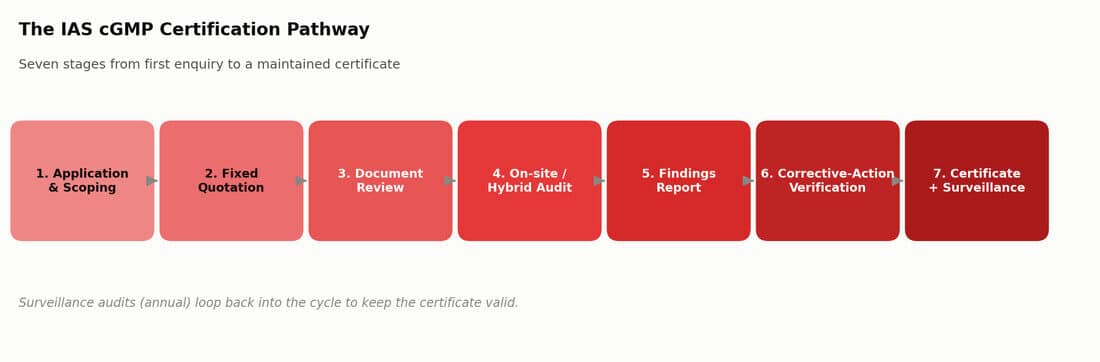
Seven stages, each with a defined output. The general IAS certification process is described on its own page.
- Application and scoping — products, site and target markets fix the audit scope.
- Fixed quotation — the full cycle, surveillance included, in writing.
- Document review — gaps surface before anyone travels.
- On-site or hybrid audit — production walk-through and batch-record sampling, following the audit procedure.
- Findings report — prioritised, actionable nonconformities.
- Corrective-action verification — at your pace, with IAS verifying the evidence.
- Certificate issue and surveillance — annual surveillance, then recertification at cycle end.
Certification Timeline and Validity
Duration varies with scheme, product category, facility complexity and, above all, the state of your existing quality system. IAS does not quote a standard number of weeks.
- Preparation is the great divider. A living quality system moves faster than one built from scratch.
- Corrective-action closure is the main variable. The audit occupies defined days; how quickly you close findings sets the calendar.
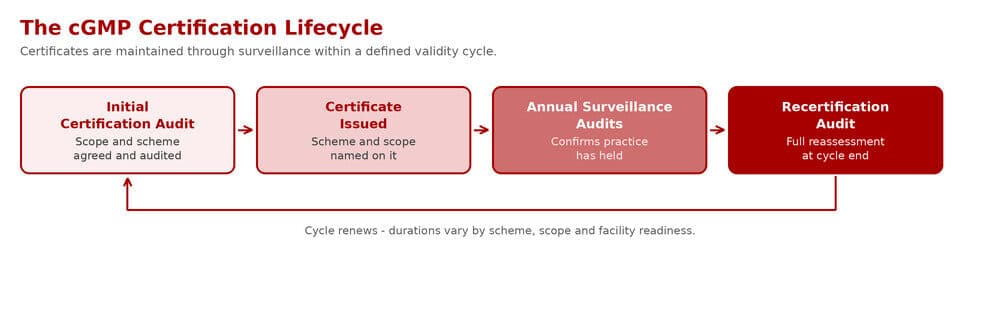
- The certificate lives in a cycle. It is issued for a defined validity period, maintained by annual surveillance, and renewed by recertification.
cGMP Certification Cost: What Drives It
GMP certification cost questions deserve honest answers. No credible body publishes a flat price, because audit duration — the cost engine — depends on your facility rather than on a generic rate card.
| Cost driver | Effect on fee |
|---|---|
| Site size and layout complexity | More area and more zones mean more audit hours |
| Number of product families in scope | Each family adds records, processes and sampling |
| State of existing documentation | A working quality system audits faster |
| Shift patterns | Multi-shift operations may need extended coverage |
| Optional gap analysis | Adds a pre-audit day, and often shortens the overall journey |
| Surveillance cycle | Annual audits, included in the IAS quotation up front |
What Is Included in Your Fixed Quotation
- The full audit-cycle scope, stated in writing before you commit
- Annual surveillance fees, disclosed up front rather than billed as a surprise later
- A named contact for the full certification and surveillance cycle
- A realistic stage-by-stage plan rather than a generic timeline
Want a real number rather than a range? Send your product categories and site details and IAS will quote in writing.
Common Nonconformities and How to Avoid Them
Findings recur across audits in the region, though their weight depends on the scheme and product category.
- Stale SOPs describing a process the plant no longer runs — the exact opposite of current.
- Incomplete batch records with missing signatures, retrospective entries or uncontrolled corrections.
- Training that stops at induction, with no requalification, and calibration gaps on instruments still in use.
- Process changes that bypassed change control — unrecorded line or parameter changes.
- Complaint logs without trend analysis, feeding CAPA only when someone remembers to.
- Data-integrity weaknesses such as shared logins, unsecured spreadsheets and missing audit trails.
None of these requires heroic investment. They require a system that is genuinely lived in — which is what a trained internal audit team provides between external visits. Many sites pair the certification cycle with cGMP internal auditor training in Singapore or broader ISO training for the whole quality team.
What Certified Singapore Manufacturers Gain
Market access
Smoother supplier qualification with multinationals, importers and retail chains; fewer duplicate second-party audits where customers accept the certificate; stronger tender files; and a verifiable differentiator in a market where competitors self-declare quality.
Operations
Batch-documentation discipline that reduces deviations and rework, earlier detection of ageing practices before they become findings, and a CAPA culture that turns problems into system improvements.
Reputation
Independent proof behind every quality claim, confidence in front of customer auditors, and staff working within a system that has been externally validated.
Why Manufacturers Choose IAS in Singapore
- UQAS accreditation. IAS certifies under the accreditation it holds, and the certificate names the scheme and scope assessed.
- Regional fluency. Auditors working across Southeast Asian manufacturing every week rather than flown in for a single visit.
- Audits written to be used. Prioritised, specific findings reports, not boilerplate.
- Transparent economics. Fixed written quotations, surveillance included, before you commit to anything.
- Production-friendly scheduling. Audits planned around your operations, with hybrid options where scope allows.
- One relationship, many schemes. Combine cGMP with HACCP, ISO 22000 or ISO 9001 under one coordinated programme, reducing duplicated audit effort.
- Honesty about boundaries. IAS certifies; regulators license and approve. More on the organisation is on the about IAS Singapore page.
Quick Definitions
- GMP: Good Manufacturing Practice — the general heading under which manufacturing quality rules sit.
- cGMP: Current Good Manufacturing Practice — the same discipline with currency made explicit, most common in US regulation.
- Scheme and scope: the named standard and the product range it applies to, confirmed at application.
- Surveillance audit: the shorter yearly visit confirming certified practice has held.
- Recertification: a complete reassessment at the end of the certificate’s validity.
The Next Step
Send IAS your product categories, site details and target markets, and you will get a fixed written quotation, a realistic stage-by-stage plan and a named contact who stays with you through every surveillance cycle. There is no obligation to proceed after scoping. Broader questions are answered on the frequently asked questions page.
Frequently Asked Questions
Is cGMP certification mandatory in Singapore?
No. HSA and SFA licensing obligations are the legal requirements within their remits. Certification is a voluntary commercial layer, increasingly expected by export customers and supply-chain audit programmes.
Does an IAS certificate mean FDA approval, and why certify if we passed an HSA inspection?
No certificate from any body means FDA approval — that is a regulatory process with the agency itself. And regulatory outcomes are not designed for commercial sharing: an HSA inspection result is not a document you can hand a customer. Certification gives you a portable document any customer can verify, plus an external check between inspections. It supports regulatory processes but never substitutes for them.
Can a small facility afford certification?
Audit duration scales with size and scope, so smaller sites generally carry proportionally smaller fees — and the fixed written quotation lets an SME weigh the investment against real numbers rather than a range.
How disruptive is the audit?
Audit days are defined in your quotation, IAS schedules around production, and hybrid formats can reduce on-site time where the scheme allows.
What happens if nonconformities are found?
There is no public failure. Findings are reported privately with corrective-action expectations, and the certificate is issued once those actions have been verified.
How long is a cGMP certificate valid, and how can customers verify it?
Certificates run on a defined validity cycle, maintained by annual surveillance, with recertification at cycle end. The exact duration depends on the scheme and scope agreed at application, and anyone can confirm a certificate’s status through the IAS certificate search page.