cGMP Internal Auditor Training in Singapore
cGMP internal auditor training teaches you how to plan, conduct, record and report an internal audit of manufacturing and quality processes against current Good Manufacturing Practice requirements. It is a skills course: you learn what to look at, what questions to ask, what counts as evidence, and how to write a finding someone can actually act on.
For manufacturers in Singapore supplying regulated and export markets, that skill sits close to the day job. Customer audits, supply-chain questionnaires and regulator visits all ask the same underlying question: does the plant run the way its documents say it runs? An internal auditor is the person inside the company who checks that first, while there is still time to fix it.

What Is cGMP Internal Auditor Training?
It is a structured course preparing employees to carry out first-party audits — audits of their own organisation — against GMP and cGMP requirements and the company’s own procedures.
The “c” in cGMP means current. Systems, documentation and training are expected to stay up to date rather than being set up once and left alone. Internal auditing is the routine mechanism that keeps them current, which is why the training is usually treated as core quality-system capability rather than an optional extra.
The course covers three things: what GMP and cGMP expect of a manufacturing operation, how an audit is structured from planning through to follow-up, and how an auditor behaves — impartial, evidence-based, and useful rather than adversarial.
What the training is not
It is not a certification scheme for your company, and it is not a licence, approval or registration. Completing internal auditor training qualifies a person to perform internal audits within their organisation. Third-party assessment of the organisation itself is a separate exercise, covered on the cGMP certification in Singapore page.
GMP and cGMP in one line
GMP is the general term for good manufacturing practice requirements. cGMP is the same discipline with an explicit emphasis on staying current, used mainly in the US regulatory context. For an internal auditor the practical difference is small: both are audited by comparing documented requirements against what is actually happening on the floor.
Why cGMP Internal Auditing Matters
An external audit is a snapshot taken by someone who visits occasionally. An internal audit is a running check by people who are there every day. The value comes from that frequency — problems are found while they are still small and cheap to correct.
Certain weaknesses turn up again and again in manufacturing quality systems, and a trained internal auditor knows to look for them.
- SOPs that describe a process the plant no longer runs — the exact opposite of current
- Batch and production records with missing signatures, retrospective entries or uncontrolled corrections
- Training that stops at induction, with no requalification when procedures change
- Calibration overdue on instruments still in daily use
- Line or parameter changes made without going through change control
- Complaint logs that are recorded but never trended, so CAPA is triggered only when someone remembers
- Data-integrity gaps such as shared logins, uncontrolled spreadsheets or missing audit trails
None of these need heavy investment to fix. They need someone to notice them, describe them accurately, and follow up until the correction holds. That is what the training is for.
What a cGMP Internal Auditor Actually Does
Most of an internal auditor’s work is straightforward and physical. You walk the area, you read, you ask, and you write down what you saw.
Three sources, one question
A typical audit day involves comparing a written procedure against the operation it describes, then testing whether the records support it. If the SOP says the line is cleaned between products and signed off by a supervisor, the auditor watches a changeover, reads the cleaning log, checks the signature is there, and checks the recorded time is plausible against the production record.
Interviews
Asking an operator to explain how they handle an out-of-specification result usually tells you more than reading the deviation procedure does. The auditor is not testing the operator; they are testing whether the system has been communicated well enough to be used.
Objective evidence
Everything the auditor concludes rests on it: a document reference, a batch number, an observation with a date and location, a statement from a named role. “Housekeeping seems weak” is an opinion. “Three of five sampled cleaning records for Line 2 in March had no verifier signature, against the requirement in SOP-QA-014” is a finding.
The auditor then writes it up, discusses it with the area owner, and returns later to check whether the corrective action actually worked. That follow-up is the step most often skipped, and the one the training gives most attention to. The same discipline underpins the audit procedure IAS uses on third-party assessments.
Where an Auditor Looks, and What Counts as Evidence
| GMP area | What the auditor examines | Objective evidence recorded |
|---|---|---|
| Documentation | Whether SOPs are current, controlled and match actual practice | SOP number and revision, issue date, comparison against observed practice |
| Production | Line clearance, in-process checks, batch record completion | Batch numbers sampled, signatures present or missing, entry times |
| Quality control | Sampling, testing, out-of-specification handling | Test records, OOS investigation references, analyst sign-off |
| Equipment | Calibration and maintenance status of instruments in use | Calibration certificate dates, equipment IDs, due dates |
| Personnel | Training records against the tasks people actually perform | Training matrix entries, requalification dates, role assignments |
| Materials | Receipt, quarantine, release, storage conditions and traceability | Goods-receipt records, status labels, storage temperature logs |
| Change control | Whether process or equipment changes were assessed and approved | Change request numbers, approval dates, linked validation records |
| Complaints and CAPA | Whether issues are investigated, trended and closed effectively | CAPA numbers, root-cause records, effectiveness-check evidence |
Key Areas Covered in the Training
The course is built around the audit as a working process rather than around theory.
- GMP and cGMP fundamentals — quality management, personnel and training, premises and equipment, materials and storage, production controls, documentation, quality control, complaints and recalls
- Audit criteria — identifying what you audit against: the applicable requirements, the quality manual, SOPs, batch records and customer commitments
- Audit planning — defining scope, setting objectives, agreeing timing with production and building a workable schedule
- Checklist preparation — turning criteria into specific, answerable questions instead of generic prompts
- Document and record review — reading a procedure critically, sampling records intelligently, spotting gaps
- Evidence collection — observation, interviewing, sampling and verification, and recording evidence so it holds up later
- Nonconformity identification — deciding whether something is a nonconformity, an observation or an improvement opportunity, and grading it sensibly
- Writing findings — statement of requirement, statement of evidence, statement of the gap
- Reporting and follow-up — prioritised reports, review of root-cause analysis, and verification that corrective action was effective rather than merely closed
- Auditor conduct — impartiality, confidentiality, auditing areas you do not work in, handling disagreement professionally
The same core method runs through the IAS GMP internal auditor training programme delivered across the group.
How a cGMP Internal Audit Is Conducted
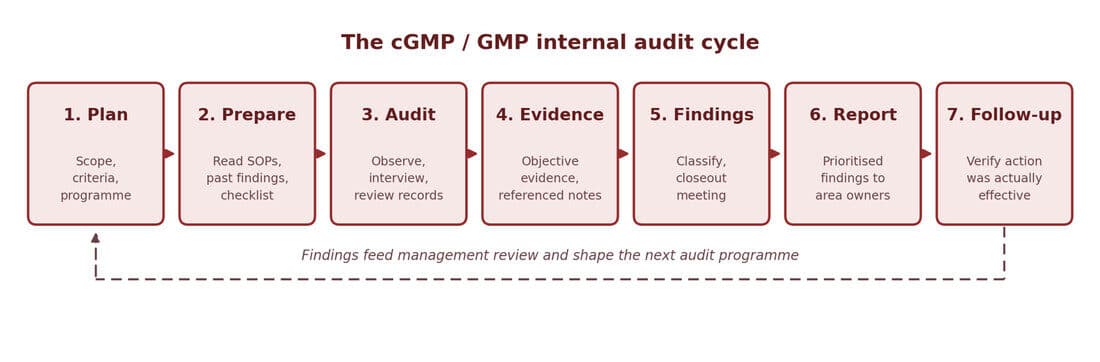
The training walks through the full cycle so participants can run an audit end to end.
Planning
The audit programme sets out which areas are audited and how often, usually weighted by risk. For a single audit you define the scope — which process, which lines, which period of records — and the criteria. You confirm dates with the area owner and issue a short plan so nobody is surprised.
Preparation
This is where audits are won or lost. You read the relevant SOPs, previous audit reports and open CAPAs before you walk in, then build a checklist. A good checklist is specific: “verify that the last three calibration certificates for balance B-07 are within date and traceable” is useful; “is equipment calibrated?” is not.
Conducting the audit
A short opening meeting confirms scope and timing. From there the auditor works through the area: observing operations, interviewing personnel, reviewing records and comparing all three against the criteria. Notes are taken as you go, with references, because reconstructing evidence afterwards never works. Where something looks wrong, the auditor widens the sample to see whether it is an isolated slip or a pattern.
Findings, report and follow-up
Findings are formed before the closing meeting, not during it. Each is checked against the evidence, classified, and worded so the area owner understands exactly what was seen and what requirement it fell short of. The report follows shortly afterwards, recording scope, criteria, people involved, evidence sampled and findings. Then the corrective action cycle begins, and the auditor verifies it — which means going back to the records and the floor, because a closed CAPA form on its own proves nothing.
The Seven Stages at a Glance
| Stage | What the auditor does | Output |
|---|---|---|
| 1. Plan | Fixes scope, criteria, dates and the areas to be covered | Audit plan issued to area owners |
| 2. Prepare | Reads SOPs, previous findings and open CAPAs; drafts the checklist | Audit checklist |
| 3. Conduct | Opening meeting, observation, interviews, record review | Working notes with references |
| 4. Collect evidence | Samples records, widens the sample where a pattern is suspected | Referenced objective evidence |
| 5. Form findings | Classifies nonconformities, observations and improvement points | Draft findings, closing meeting |
| 6. Report | Documents scope, evidence and prioritised findings | Internal audit report |
| 7. Follow up | Reviews root cause, verifies corrective action effectiveness | Verified closure, input to management review |
Who Should Take cGMP Internal Auditor Training
The course suits anyone who will audit, host an audit, or act on audit findings.
| Role | Why the training helps |
|---|---|
| QA officers, executives and managers | Usually own the internal audit programme and the CAPA system |
| QC and laboratory personnel | Clarifies how test records, calibration, OOS handling and data integrity are examined |
| Production and manufacturing supervisors | Turns audit findings into practical line-level corrections |
| Engineering, maintenance and validation staff | Covers calibration, equipment status and change-control evidence |
| Warehouse and materials personnel | Covers receipt, quarantine, release, storage conditions and traceability |
| Regulatory affairs and compliance staff | Adds a working audit method to existing requirements knowledge |
| Management representatives | Supports audit programme design and management review input |
| Consultants and internal trainers | Provides a consistent, teachable audit method to pass on |
Prior audit experience is not required. Participants already working inside a GMP quality system tend to progress fastest, because they can map the method onto processes they know. Newcomers can follow the course but should expect to spend time on fundamentals first — a cGMP foundation course is often the easier starting point. Staff who will go on to run supplier or external audits usually follow this course with ISO lead auditor training, and the same method is taught across the ISO internal auditor training range.
Skills Participants Develop
- Reading a procedure and identifying what is actually auditable in it
- Sampling records in a way that gives a fair picture of a period, instead of checking whatever is on top of the pile
- Asking open questions and listening to the answer rather than leading a witness
- Separating fact from impression, and recording evidence with enough reference detail to stand up in review
- Writing a nonconformity that states requirement, evidence and gap without blaming individuals
- Judging whether a proposed corrective action addresses the cause or only the symptom
- Reporting clearly to people who were not in the room
- Staying impartial when auditing colleagues — the hardest part of internal auditing, and the most important
What Organisations Gain
A trained internal audit team finds issues before an external auditor or a customer does, which turns external audits from a risk into a routine. Documentation discipline improves because people know records are read. CAPA stops being a filing exercise once someone verifies effectiveness. A company with its own audit capability can also assess suppliers and contract manufacturers using the same method.
Manufacturers holding third-party certification often pair the certification cycle with in-house audit capability, so the quality system is checked continuously between external visits rather than revived shortly before one.
Training and Certification Are Not the Same Thing
| Aspect | cGMP internal auditor training | cGMP certification |
|---|---|---|
| Applies to | Individual employees | The organisation and its manufacturing site |
| Purpose | Build the competence to audit your own company | Independent assessment against the applicable scheme |
| Who performs it | A training provider delivers it; your staff then audit internally | An independent certification body |
| Type of audit | First-party, internal | Third-party, external |
| Outcome | Trained internal auditors and a training record | A certificate covering a defined scope |
| Frequency | Audits run continuously through the year, per the audit programme | Initial audit, then surveillance and recertification |
| Main output | Internal audit reports and verified corrective actions | Certificate and external findings report |
Internal auditing supports certification — a certified quality system is expected to audit itself — but the two are separate activities. Completing the training does not certify a company, and holding a certificate does not remove the need for internal audits.
cGMP Internal Auditor Training in Singapore: Course Details
How long the course runs depends on the number of participants and the route chosen, and fees are set out in the same written quotation. Anyone completing it is given a certificate of completion naming the syllabus and date for your training records.
Objective
To give participants the knowledge and practical method to plan, conduct, report and follow up internal audits of GMP and cGMP quality systems.
Coverage
GMP and cGMP fundamentals; the internal audit cycle; audit criteria and scope; checklist development; evidence collection through observation, interview and record review; nonconformity classification; audit reporting; corrective action verification; auditor responsibilities and conduct.
Learning outcomes
Participants should be able to prepare an audit plan and checklist, conduct an internal audit against defined criteria, gather and record objective evidence, raise and word nonconformities, produce an audit report, and evaluate corrective actions.
Delivery options
Classroom, live virtual and self-paced online formats, and in-house delivery for a company’s own quality and production teams. Self-paced and virtual routes run through online cGMP internal auditor training and virtual cGMP training.
Getting started
If you are building internal audit capability in a Singapore manufacturing operation, the practical first step is deciding who audits what. Most companies begin by training a small cross-functional group — typically QA plus one person each from production, QC and warehouse — so that auditors can cover areas they do not work in. Send your site details, product categories and the number of participants, and IAS will advise on format and schedule.
Worth saying plainly, because not every provider does: IAS trains auditors and certifies management systems. It does not license manufacturing sites or approve products. Those remain decisions for regulators, and no training record or certificate stands in for them.
Frequently Asked Questions
What does a cGMP internal auditor actually do?
They check whether the organisation works the way its documented system says it does: reviewing SOPs and records, observing processes on the floor, interviewing personnel, sampling batch and cleaning records, comparing what is seen against the applicable requirements, recording objective evidence, raising nonconformities, writing the report, and following up later to verify corrective actions were effective.
How is a cGMP internal audit actually conducted?
The audit is scoped and planned, then prepared by reviewing relevant procedures, previous findings and open actions, and building a checklist. An opening meeting confirms scope. The auditor observes operations, interviews personnel and reviews records, noting evidence with references. Findings are classified, presented at a closing meeting and issued in a report. The area then investigates root cause and implements corrective action, which the auditor later verifies.
What is the difference between this training and cGMP certification?
Training applies to people; certification applies to organisations. Internal auditor training builds an employee’s ability to audit their own company and results in a training record. Certification involves an independent body assessing the manufacturing site against the applicable scheme and issuing a certificate for a defined scope. Internal audits support a certified system, but completing the training does not certify a company.
Is the training useful for QC and laboratory professionals specifically?
Yes, though the benefit differs from QA. The course clarifies how laboratory records, calibration, out-of-specification handling and data integrity are examined during an audit, which improves how those areas are documented and defended when a customer or external auditor arrives.
Can beginners take this course?
Yes. It assumes no previous auditing experience and starts from fundamentals before moving into technique. Participants already working within a manufacturing quality system find the material easier to apply. Those entirely new to GMP may prefer a foundation course first.
What skills can I use immediately afterwards?
Preparing a focused audit checklist, sampling records in a defensible way, asking open questions during interviews, distinguishing objective evidence from impression, writing a nonconformity that states requirement, evidence and gap clearly, producing a readable report, and judging whether a proposed corrective action addresses the cause rather than the symptom.